
Unlocking Private Capital Markets: Discovery, Diligence And Delivery
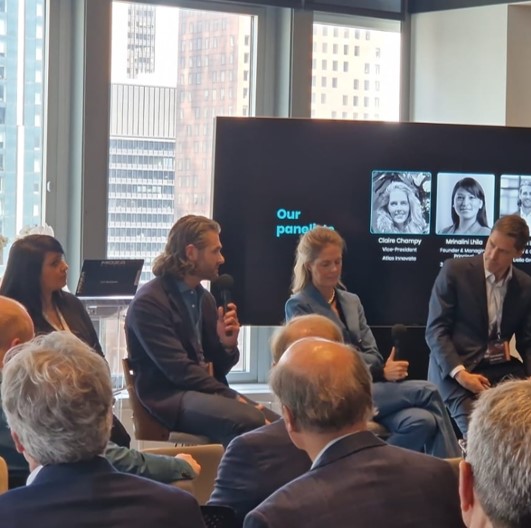
In today”s private markets, access is abundant. Execution is the differentiator. This was one of the conclusions arrived at in a panel discussion about how family offices should approach the rapidly-expanding world of private market investing. The panel was held at the recent Family Wealth Report Family Office Investment Forum in New York.
In a continuing series of reports about panel discussions at
the recent
Family Wealth Report Family Office Investment Forum, this
panel looked at the rapid growth of private markets, and how they
should be considered.
The speakers at the panel were Claire Champy, vice president
at Atlas Innovate; Gareth Lewis, founder and CEO at Delio, and
Mrinalini Lhila, founder and managing principal, 360 Capital
Advisors. The panel was moderated by Maxime Seguineau, founder
and managing partner at Raido Capital Advisors.
(Main photo, from left to right: Mrinalini Lhila; Gareth
Lewis, Claire Champy, and Maxime Seguineau.)
Introduction
As private capital markets continue their rapid evolution, the
ability to access, evaluate, and deploy capital with precision is
becoming the true differentiator between success and
stagnation.
The panel delivered actionable insights into how family offices
and private investors are sharpening their approach across the
full investment lifecycle.

Private markets at an inflection point
Public markets have shrunk dramatically over the past two
decades: fewer than 15 per cent of companies generating over $100
million in revenue are publicly listed today. Meanwhile,
individuals and families control nearly half of global wealth,
but still account for only 16 per cent of assets managed by
alternative investment funds.
At the same time, private capital markets have swollen to
$13 trillion in AuM, with forecasts projecting growth to $20
trillion – or even $30 trillion – by the end of the
decade. Family offices are stepping in: the average family office
now allocates around 22 per cent of its portfolio to private
equity, and 57 per cent expect to increase their private market
exposure in the next two years.
Discovery: Sourcing in a crowded market
Sourcing differentiated deal flow is becoming harder, not easier.
Claire Champy emphasized that even family offices with dedicated
internal teams rarely match the sourcing reach of established
private equity sponsors.
The solution? Collaboration. Rather than attempting to compete
across all sectors, family offices are better served by forming
trusted partnerships with a select few specialized sponsors, each
offering depth in a particular industry or strategy.
Mrinalini Lhila reinforced this view: “It’s not about volume
anymore – it’s about fit, alignment, and bringing forward
opportunities that truly match the family’s thesis.”
While private equity deal volume rebounded in 2024 – with
global buyout activity up 37 per cent by value – dry powder
remains abundant, heightening competition and making sourcing
discipline even more critical.
Diligence: Precision matters more than ever
As competition for deals intensifies, diligence has evolved from
standard checklists to a much more dynamic, granular process.
Gareth Lewis highlighted that the rise of wealth technology
platforms is enabling faster, more transparent pre-close
diligence.
“In private markets, opacity used to be accepted. Today,
investors demand clarity on operational execution, valuation
assumptions, and reporting practices – before they commit a
dollar,” Lewis said.
Technology is also transforming the diligence process itself,
with AI-assisted evaluation becoming a standard practice across
leading investment firms.
Delivery: Where trust Is cemented
Investors are increasingly scrutinizing what happens after the
capital is deployed. Delivery – meaning administration,
reporting, and ultimately exits – is now viewed as an
extension of brand trust.
Gareth Lewis emphasized, “Delivery is no longer just an
operational task – it’s the final proof of your promise to
investors.”
This focus is especially critical amid a backdrop of longer
holding periods. Clear reporting, proactive communication, and
aligned expectations are no longer optional – they are
mandatory.
Family Offices: Flexibility Is an edge – if paired with
discipline
Family offices possess a structural advantage in their direct
mandates over institutional investors: flexibility. Unlike LPs
wholly locked into closed-end fund cycles, family offices can
move opportunistically during periods of market dislocation
– and often extract better valuations and terms when others
step back due to timing or rigid processes.
However, this advantage only translates into superior returns if
paired with discipline and rigorous diligence. Flexibility
without structure invites risk. Flexibility with discipline
unlocks premium returns.
Closing insight: Execution is the
differentiator
In today’s private markets, access is abundant. Execution is the
differentiator. As Maxime Seguineau summarized: “Discovery is a
network. Diligence is a discipline. Delivery is a promise. And in
today’s market, the firms that win are those that can keep all
three aligned at scale.”
About Raido Capital Partners
Raido Capital Partners is an independent sponsor investing in
technology companies powering the financial domain. With an
investor base consisting predominantly of family offices and
UHNWIs, it sources and structures deals from its proprietary
network and provides operational augmentation post-investment.
The firm’s general partners bring a wealth of experience as
executives in investment management and enterprise software, as
well as founders who have built and successfully exited
technology businesses.
link