Influence of the service marketing mix on audience decision-making in Mongolian performing arts
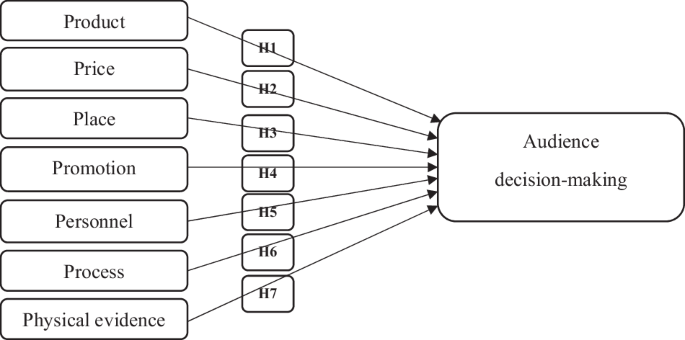
The literature review addresses a wide range of topics, including performing arts in Mongolia, consumer decision-making, and the service marketing mix (7Ps), to explore how these elements influence audience decision-making in the Mongolian performing arts sector. The study’s framework is presented at the end of this section.
Performing arts in Mongolia
The National Academic Theatre of Opera and Ballet of Mongolia and the Mongolian State Philharmonic are the two principal performing arts institutions in Mongolia. Both institutions were established in the 1960s. In 1990, Mongolia transitioned to democracy, bringing new challenges to Mongolian society. Cultural and arts institutions, including performing arts organizations, struggled due to limited funding, insufficient resources, and inadequate facilities to sustain their activities. Furthermore, the market and audience size declined (ACM, 2011). Following the severe recession, performing arts organizations entered a new phase of development under cultural policies implemented since 1996 (MOC, 2021). Mongolia is rich in cultural traditions and heritage, including the Morin Khuur, Khoomei, Tsuur, Tuuli, Epic, and traditional folk music and dance, which serve as sustainable cultural resources. The main objective of cultural marketing policy is to promote and market these unique cultural products locally and internationally (Gantumur, 2016). Performing arts organizations were initially unfamiliar with the concept of marketing, as marketing departments were only recently established. As a result, the understanding of marketing was initially limited to simply advertising performances and concerts to the public (Narantsatsral, 2017). A study revealed that audiences often missed event due to a lack of information (Baasanjargal and Natsagdorj, 2020). These organizations need to bridge the gap with their audiences by implementing effective marketing efforts, building stronger connections, reaching potential customers, and gaining deeper insight into market needs. To address these gaps, organizations have embraced marketing and customer research, developing appropriate programs, plans, and strategies (Academic Theater of Opera and Dance, 2013). Furthermore, the use of social and digital marketing has become essential in improving service, promotion, and accessibility, especially since nearly 80% of the population has access to digital media (Kemp, 2023).
Consumer decision-making
Understanding the reasons behind consumer behavior and purchasing decisions has always been a crucial topic in marketing. This knowledge helps marketers develop effective marketing strategies and remain competitive in the marketplace. Marketers are required to investigate a range of factors, including economic, social, cultural, and psychological factors, to better understand how consumer motivation and decision-making vary among products (Stankevich, 2017). There are numerous definitions of consumer decision-making. The broadest definition is the process of selecting among alternatives based on specific considerations. In the arts, it is also important to understand the conditions under which audiences decide to attend events (Becker, 2023).
Individuals make purchasing decisions in their daily lives to satisfy their needs and wants. Similarly, arts consumers become aware of their desires, which can be triggered by external influences such as advertisements or word of mouth, or by internal stimuli such as a desire for an enjoyable and pleasant weekend (Kotler and Scheff, 2009). Subsequently, the arts audience seeks additional information, often drawing from personal experiences. Various sources may be consulted, including public sources, commercials, and recommendations, as well as insights from family, friends, or colleagues (Hill et al., 2018). Decision-making for arts events is more complex, often involving groups rather than individuals, where decisions may be shared or influenced collectively (Kotler, 2003). Purchasing a ticket is not merely transactional-audiences attend live performances to observe artists, enjoy real-time experiences, and appreciate the venue’s ambiance, staging, and design (Dominique, 2000). After attending an event, audiences evaluate their experiences. If the experience meets their expectations, they are more likely to attend future performances and recommend them to others (Kolb, 2013). However, if customers’ experiences fail to meet their expectations, they may share negative feedback with the public, potentially causing harm to arts organizations. Therefore, marketers of arts organizations must consider all influencing factors, especially the marketing mix, which organizations can directly control to influence audience choices and re-attendance.
Currently, the understanding of audience decision-making in the performing arts is limited. This knowledge gap is a crucial area of exploration that could assist marketers in formulating more effective strategies for attracting and retaining customers (Han and Kang, 2020). Identifying key factors in audience behavior, establishing strategic managerial responses, and understanding post-purchase influence are all essential (Cacovean et al., 2021).
Scholars use theoretical perspectives to understand the diverse factors influencing audience decision-making in the arts and performing arts sector. For example, one of the most commonly used theoretical frameworks is the Theory of Planned Behavior (Ajzen and Driver, 1992), which highlights how attitudes, subjective norms, and perceived behavioral control shape decision-making, particularly in service-based contexts. Similarly, Lovelock et al. (2011) service quality framework aligns with the 7Ps model, emphasizing both tangible and intangible factors. The Service Quality Models (SERVQUAL) is also widely used to assess satisfaction, focusing on venues, performances, and customer service. In the performing arts, organizations often involve audiences directly during the service process, making elements such as personnel and processes particularly influential (Akroush, 2011). However, previous studies have not sufficiently examined how these key elements impact audience decisions. In Mongolia, where traditional and contemporary values coexist, personnel and process may play an even greater role. Given that this is one of the first empirical and fundamental marketing studies in the field of performing arts in Mongolia, this research aims to examine how audiences evaluate the service marketing mix components and how these affect their decisions. This research is grounded in the service marketing mix (7Ps) framework, which provides a robust theoretical foundation for the study. The 7Ps framework is widely accepted in service marketing literature and has been successfully applied to various contexts, including the performing arts, hospitality, and other experience-based industries. The 7Ps framework is particularly suitable for analyzing audience decision-making in the Mongolian performing arts sector for several reasons. First, performing arts are inherently service-driven, where intangible experiences, interpersonal interactions, and the overall environment significantly influence audience perceptions and decisions. Second, the framework’s inclusion of people, process, and physical evidence aligns well with the unique cultural expectations and values in Mongolia, where human interactions and cultural authenticity play a critical role. In this study, the 7Ps framework provides a structured approach to evaluate how each marketing mix element product, price, place, promotion, people, process, and physical evidence impacts audience decision-making. By grounding this study in this framework, it offers a sound theoretical contribution while addressing practical needs in Mongolia’s performing arts sector.
Service marketing-mix (7Ps)
The elements of the traditional marketing mix, known as the 4Ps, were originally developed by McCarthy in the 1960s. These 4Ps consist of product, price, place, and promotion. Companies need to control and administer these components to fulfill customers’ needs and wants while providing suitable solutions to meet the desires and requirements of their target markets. For businesses, companies, and organizations, the 4Ps represent a group of controllable elements that the companies can use to address both the short and long-term needs of customers while also maximizing their profits (Wichmann et al., 2022).
The consumer goods industry differs from the service sector due to the contrast between tangible goods and intangible services. In the field of service organizations, the 4Ps were found to be insufficient due to their specific characteristics. Therefore, Booms and Bitner (1981) introduced an expansion to create the seven Ps, which include three additional elements: people, process, and physical evidence. These 7Ps constitute a service marketing mix, which serves primarily and effectively in contemporary service marketing paradigms (Batat, 2022). The extended marketing mix is also commonly applied in the performing arts sector and is expected to influence audience decision-making.
Product/Service
A product is any tangible or intangible offering that fulfills customer needs (Kotler and Armstrong, 2018). Tangible values refer to goods and products that are distinguished by their brand, quality, design features, and packaging (Akbar and Hoffmann, 2020). In contrast, intangible values refer to services characterized by their unique experiences (Akroush, 2011). In the performing arts sector, concerts and performances serve as the core products. The quality of performances significantly impacts audience satisfaction and re-attendance. Product quality and reputation are key factors in retaining and attracting audiences (Sønning, 2024). If the audience’s experience meets their expectations, they are more likely to attend performances regularly and become loyal members. Based on the literature review, the following hypothesis was formulated:
H1: Product has a positive influence on audience decision-making.
Price
Price refers to the value offered to customers when purchasing, possessing, or utilizing a good or service. It also encompasses the policies and practices that service organizations use to establish the cost of an exchange (Akroush, 2011). In service organizations, price is an essential factor in evaluating quality since there are no tangible indicators to measure quality (Singh et al., 2022). When deciding among service providers, customers tend to pay more attention to price than other characteristics (Peter and Donnelly, 2013). This is because they consider the value of their effort, money, and energy based on their past experiences before making a repeat purchase. Price has historically been identified as one of the key elements affecting purchasing decisions. This concept also applies to the performing arts discipline, where the cost of admission tickets is a major barrier to participation in artistic activities (Cacovean et al., 2021). Performing arts organizations offer free tickets and discounted admission tickets and subscriptions to attract new audiences, maintain consistent visitor numbers, increase audience numbers, and boost audience loyalty (D’Astous et al., 2009). The literature review served as the basis for developing the following hypothesis:
H2: Price positively influences audience decision-making.
Place
In both goods and service organizations, the place or distribution channel refers to how the product or service is delivered to the consumer (Park, 2020). In the performing arts field, place encompasses various aspects of the location, including the venue, parking, building, facilities, and seating capacity (Byrnes, 2022). When venues are far from the audience’s location, they tend to spend more time traveling. Moreover, location has a significant positive impact on audience decision-making (Liberato et al., 2024). The distance and travel time affect participation, making location a key factor in attendance decisions. According to the literature review, one of the main obstacles to participating in performing arts activities is a lack of time. Therefore, the location and distribution of the event are crucial factors in audience decision-making (Park, 2020). Based on the literature review, the following hypothesis was formulated:
H3: Place positively influences audience decision-making.
Promotion
Promotion is how service organizations communicate with and influence target audiences (Wirtz and Lovelock, 2022). Products and services provided by an organization are ineffective if customers are unaware of them. Promotion can be categorized into sales promotion, direct marketing, advertising, public relations, and personal selling (Akbar and Hoffmann, 2020). In the context of performing arts marketing strategy, promotion plays a crucial role in engaging current audiences and addressing the interests of potential customers. Promotion strategies are selected based on the target audience, with public relations being the most widely used technique in the field (McDonald and Harrison, 2002). Based on the literature review, the following hypothesis was formulated:
H4: Promotion has a positive impact on audience decision-making.
Personnel
In service organizations, employees are referred to as personnel, and they play a significant role in the delivery of services (Xu et al., 2023). Their performance, attitude, and quality have a direct impact on customer satisfaction. Therefore, it is important to ensure that the service staff’s performance is of high standards. Customer ratings of the service are influenced by the staff’s performance (Byrnes, 2022). According to the literature, employees of a service organization can have a significant impact on audience decision-making through their interactions and communication with audiences (Coman et al., 2023), the establishment of strong connections, and prompt problem resolution (Neil et al., 2008). Based on this, the following hypothesis was stated:
H5: Personnel have a positive influence on audience decision-making.
Process
Process refers to the flow of activities and operations performed during the delivery of services, which create a value proposition in the minds of customers (Salloum and Ajaka, 2013). Studies have shown that customer purchasing decisions in the service industry are significantly impacted by the process (Preko and Gameti, 2014). Audience perceptions of events are shaped by their experiences during the service process. These experiences influence future purchasing decisions (Byrnes, 2022). Technology has significantly transformed the delivery of services, even in the performing arts sector, making it easier to connect with younger and more educated audiences (Akbar and Hoffmann, 2020; Colbert and Rentschler, 2009). Based on the literature review, the following hypothesis was proposed:
H6: Process has a positive influence on audience decision-making.
Physical evidence
This section describes the tangible elements that contribute to creating a positive and functional atmosphere for a service organization (Akroush, 2011). Customers often find it difficult to evaluate the quality of services due to their intangible nature, so they use the service environment as a substitute for quality. The physical atmosphere has a significant impact on customers’ future purchasing decisions (Zeithaml et al., 2013). Performing arts organizations rely heavily on the management of performance spaces, including stage design, lighting, and hall decor. These elements must be carefully coordinated to ensure a profound experience for the audience (Caraba and Cosma, 2021). Therefore, effectively controlling the service and environment is essential for marketing performance (Courvoisier and Courvoisier, 2007). Based on the literature review, the following hypothesis was generated:
H7: Physical evidence has a positive impact on audience decision-making.
Based on previous studies (Phusist, 2015; Day, 1983), the researchers propose the following conceptual framework (Fig. 1) to assess the impact of the service marketing mix on audience decision-making in Mongolia.
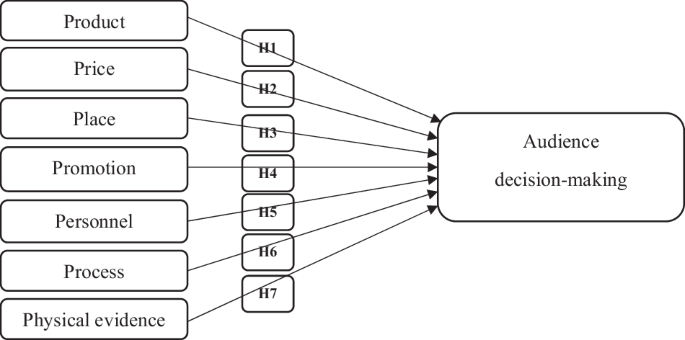
The framework illustrates each element of the 7Ps as independent variables, with audience decision-making as the dependent variable.
link