
Korea Zinc’s US smelter project: Strategic, timely move amid supply chain shifts

Korea Zinc Inc.’s decision to establish a smelter in Tennessee is a strategic response to a global supply chain realignment increasingly driven by national security priorities, according to business and legal experts.
As US-China rivalry over critical materials intensifies, the investment goes beyond a market entry. It marks a move to integrate into the US supply chain, positioning Korea Zinc as a key player in the global critical minerals industry.
During a panel discussion hosted by The KED Global on Thursday, business and law professors said the $7.4 billion project is structured to serve the interests of both the US and Korea Zinc, the world’s largest non-ferrous metals smelter.
In December, Korea Zinc agreed with Washington to build a smelter in Tennessee through Crucible JV LLC, a joint venture in which the US Department of War will take an equity stake, along with strategic investors.
As part of the arrangement, Crucible JV this week secured a 10.59% stake in Korea Zinc through a third-party paid-in capital transaction worth $1.94 billion.

“The investment should be evaluated not from the perspective of short-term returns, but as a strategic decision that defines Korea Zinc’s place in a global supply chain increasingly shaped by national security,” said Ryou Hyo-sang, head of the Unicorn Business Management Research Institute.
The panel discussion focused on the theme: Strategic overseas investment and corporate value creation.
“Despite holding significant critical mineral resources, the US lacks sufficient domestic smelting capacity and technology to process them at commercial scale,” Ryou added.
LONG-TERM BENEFITS
Korea Zinc will manage the smelter as a wholly owned subsidiary, while contributing about 10% of the project’s total financing.
In return, it will grant the US government warrants allowing it to purchase new shares in the smelter operating entity, Crucible Metals, for one cent per share.

The project could face vulnerabilities related to potential technology leakages, as well as exposure to regulatory shifts and environmental compliance requirements.
However, the panelists agreed its longer-term benefits would outweigh the potential downsides.
Once the smelter begins operations as scheduled in 2029, it is expected to generate about $900 million in earnings before interest, tax, depreciation and amortization (EBITDA), equivalent to Korea Zinc’s current EBITDA.

“This is the kind of opportunity where the downside risk is extremely limited, while the strategic upside is significant,” said Yoo Byungjoon, a professor of business administration at Seoul National University.
“By directly sourcing capital in partnership with the US, the company is able to share risks effectively.”
He explained that the approximately $4.7 billion in debt is structured as a 15-year long-term loan, providing sufficient time for the smelter to reach stable operations and generate cash flow without near-term repayment pressure.
The professor also noted that US government policy financing is secured at interest rates 50 to 125 basis points below market levels.
“With around 3 trillion won financed through equity, the project is expected to improve key financial stability indicators without imposing an excessive debt ratio burden,” Yoo explained.
He referred to the $1.94 billion, or about 3 trillion won, which Korea Zinc secured through a third-party equity placement this week to inject into the smelter oeprating unit.

REGULATORY PERSPECTIVES
Yoo Hyesun, a professor at Hanyang University School of Law, said that Korea Zinc’s investment in the US should be evaluated from the perspective of securing eligibility for benefits under the US regulatory framework, including the Inflation Reduction Act, the CHIPS Act and Executive Order 14241.
Executive Order 14241, issued in March 2025, aims to accelerate mineral production by fast-tracking permitting for mining, processing and smelting projects across the US, including those involving critical minerals.
“This (deal) structure was largely unavoidable to grant the US government the necessary legal authority to participate,” she added.

SUPPORT FOR VALUATION
Lee Young-min, a professor at Seoul National University College of Business Administration, said the US investment would support Korea Zinc’s valuation, which appears to have overshot its fundamentals amid a prolonged management disputes with MBK Partners.
Shares of Korea Zinc are now trading at around 1,200,000 won ($830), equivalent to roughly 75 times its earnings.
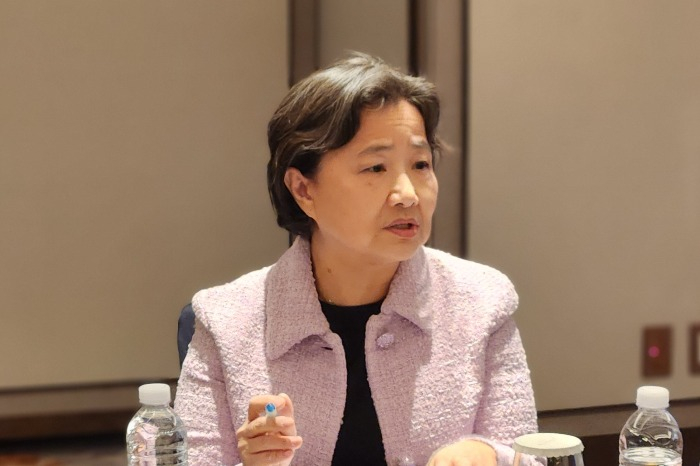
“By securing Washington’s financial and political commitments, Korea Zinc has established an entry barrier that competitors cannot replicate,” said Choi Gyoung-gyu, a professor emeritus at Dongguk University.
link